In this week’s material that is been given to read, listen and watch. The main focus of the material I have seen is on the topic that what social media is doing to human life. Every passing day, month or year is bringing new and interesting apps on the social media platform and taking us away from the real life.
This week’s episode of the Black Mirror: 15 Million Merits, in this episode we all see how Bing met with Abi and convinces her to participate in the talent show and how this lead this girl to loss her dignity. I mean we crave to have fame and limelight but while perusing we fail to understand that everything comes with a price.
in the article: “Cicero’s Twitter: Tom Standage on the forgotten history of social media”, the author said that humans from the start have the habit of communicating in a very private form. Social media has given us nothing more than just more room to communicate with a lot of people but still we use the chat boxes to have our deep conversations. He said “The central premise of the book is that from Cicero to Thomas Paine to Mark Zuckerberg, people have always communicated in very personal ways. Yet we often hear people talking about “social media” as an entirely new phenomenon. Why is it so easy for people to forget this history?”
I think the author has said right about this phenomenon. People when come to sharing do not trust easily and still find ways to share in a more private way. Social media has given us nothing more than that.
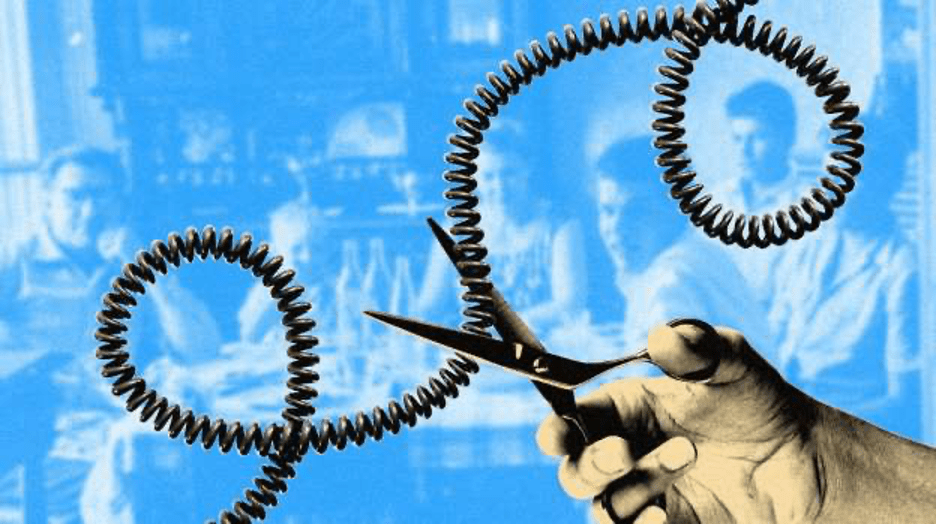
After this I have read the article: “How the Loss of the Landline Is Changing Family Life”. I found the topic of this article interesting to know what impacts social media has put to the family as a whole. We often see people saying that now every person of the house has his/her own cellphones and that’s why they do not have a landline communication. I mean while saying so, they still did not see what these cellphones have charged them with the price? The price of their “Family time”. Landlines were used to be a common sharing place for the families and the whole family gather at the landline spot to talk with their loved one. What the cellphones have done is that they have taken this family time and replaced it with the virtual rooms and chatting groups where the same family members are connecting virtually from their own rooms.
From all these readings and watching, what I found is we are being indulged so much in the social media that we forgot our actual life, our family time and our me time too. The social media’s addiction is so powerful that we do not find it easy to stop scrolling and turn the Wi-Fi off to relax our eyes. My question to all of you is
Does the social media is that much powerful or we made it so?
Who gave this power to social media? US?
I have found this article related to this week’s topic that social media is improving or in other words empowering itself in order to grab more of our time.
This week, we were reminded of our addictions to our phones and social media. We are constantly reminded of this by our elders and by anti-tech media. I think the more interesting idea that was presented this week was the fact that our addiction is rooted in our DNA. Corporations like Apple, Facebook, etc are simply capitalizing on these behaviors.
The articles “The Ancient Foundations of Social Media” and “Tom Standage on the Forgotten History of Social Media”, explain the concept that social media has already existed for most of human existance. According to them, humans are wired to socialize and to gossip. Standage sums this up pretty well when he states, “Modern social media is so compelling because it’s the most convenient and efficient means we have invented so far to scratch a prehistoric itch: the desire to share and network with other people.” After sitting back and thinking about this, I believe this concept to be true. Social networks only give us an advanced platform to do what we already do: we gossip, we speak our minds, we judge people, and we look for concurrence from our peers while receiving judgement from our foes. This was previously done in coffee shops, in school, in newspapers, etc. Social media does all of these same things from afar; we can post our thoughts and ideas, and just about anybody can make comments on them or leave a “like”.
Regardless of how we get it done, we are in need of human interaction. I believe this is why we are so addicted to our phones; it offers a constant broadcast of what everyone in and outside of our circle is doing. However, in order to capitalize on these tendencies, companies go out of their way to make it more addicting for us. For example, in the Marketplace video we watched, it mentioned Snapchat streaks. That is a for sure way to tempt users to get on the app at least once a day. I remember when streaks first came out, there was a huge pressure to keep your streaks with people. Your friends would even get mad at you at times if you lost their streak (it sounds funny written out, but this was real life!). All apps send out daily notifications in order to tempt us to tune in. Facebook sends personal notifications about how much your friends have been posting or how much you’re missing out. Every app has its tactic, but the bottom line is, with each visit to a website or platform, you are left wanting more.
This idea also comes into play when we talk about how we can craft our personalities on social media. In the article “I Tweet Therefore I Become”, we see how addicting creating your ideal persona can be. Through social media we can shape the idea of ourselves in a way that we cannot do in person. I have seen this cause anxiety for some people and I’ve seen it become an opportunity for others. Some people become anxious at the idea of meeting someone in person because of the ease of relaying your (ideal) personality online. I’ve also seen people who take the opportunity to express themselves and use the platforms to their benefit. It all depends on the person, but either way, it has its positive and negative side effects.
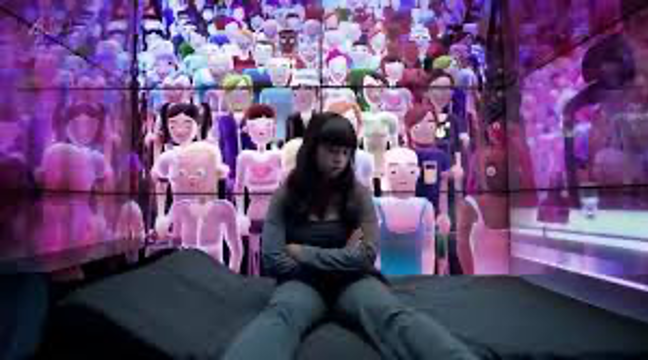
Another big lesson attached to these ideas came from this weeks Black Mirror episode. In the episode, screens are EVERYWHERE.
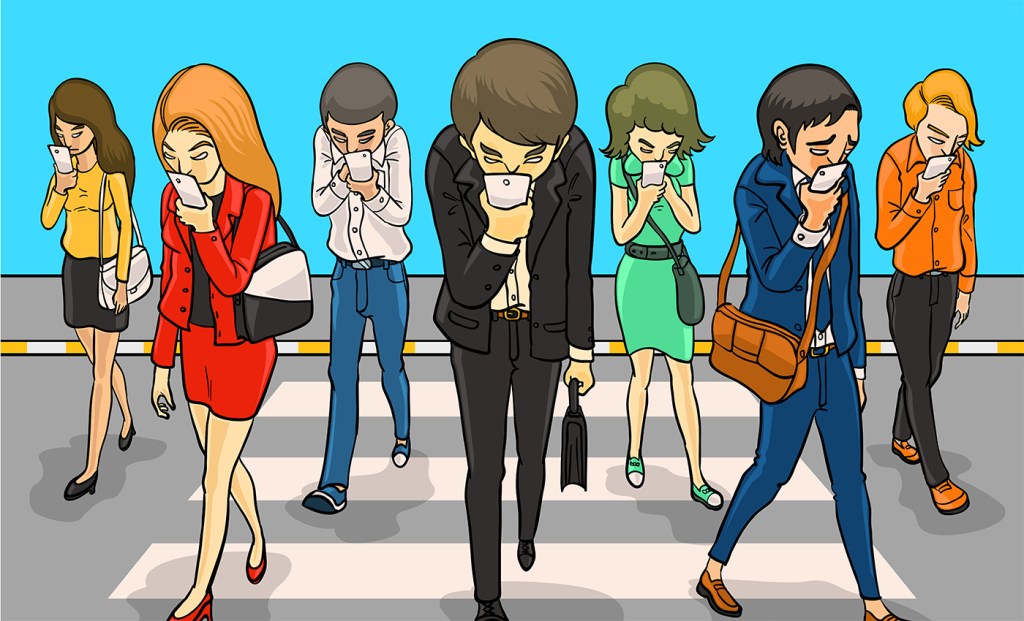
In a sense, this is how we walk around today. People walk around with their phones in their faces and their headphones in; it’s so normalized that eye contact can be awkward. They are even pressured into viewing different applications, getting a penalty on their currency if they skip whatever is playing on their screens. When Wraith Babes comes on, Bing was tempted to watch even though he wasn’t initially into it. This is the type of pressure that I was explaining previously where tactics from companies lead to an addiction to content. The episode did a good job of showing how we gravitate towards being famous over the idea of being a working person as well. The show Hot Shot was their rags to riches opportunity. When Abi gets the opportunity to leave the bikes on Wraith Babes, she is pressured to take the opportunity, just as we are pressured to use social media and reap the “benefits” from it, regardless of how the benefits come.
You can make a perfectly reasonable living without fame. Why are we so caught up on the idea of being famous? Do you think this mindset is beneficial?
This was interesting to me because I didn’t even know that sagging your pants was a law before now. It’s something a little less dark than most recent news.
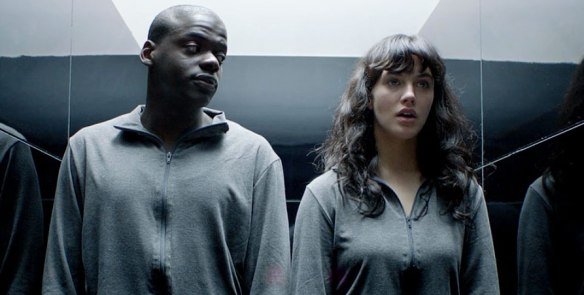
As 2020 progresses, the digital media continues to play a huge role in innumerable people’s lives on a daily basis. The need for having a cellphone on hand has become a norm all around the world. In the ‘Black Mirror’ episode, “15 Million Merits”, it showed a life ruled by social media expectation, status and overall takeover consumption of technology. This episode shows what capitalism, narcissism and technology can potentially do to the world. This episode was aired in 2011 which closely predicted the world we are currently living in 2020. People are more consumed to their technology than to the reality of the world. In the episode, people lived around each other in what looked like a huge building with no windows to the outside world. People were awoken surrounded by television screens and had electronic sensory doors, toothpaste squeezers and camera television screens. The norm was to exercise on a stationary bike exercise machine while having the screen options to watch an X-Factor styled show called “Hot Shots”, use their digital avatars to ride their bikes through various digital sceneries and even learn or practice playing an instrument. Exercising on the bike will grant digital money to be used to buy food, porn, games and a ticket to audition for “Hot Shots”. These people are dressed in grey while other people, who happen to be larger in size, don’t get the opportunity to use the bikes to gain money or digital popularity. They are deemed as lower class people than the ones dressed in grey and wear yellow while cleaning up for the ‘upper class’ people. The upper class people don’t usually engage with one another as much as they do with their technology. With Bing, the main character, wanting freedom and finding Abi as verified to sing for “Hot Shots” he bought the tickets to audition. Before auditioning they were required to drink ‘Cuppliance’ drink which was created so that humans don’t have a meltdown on stage. Abi drinks the drink while Bing does not. Abi sings beautifully to the judges and digital audience, but the judges discard her singing abilities and attest that she was the perfect innocent candidate for the porn industry. One judge is convincing Abi by telling her “You will never have to pedal again, not one minute. We can really work with you”. All while Bing was being taken away for trying to run on the stage to stop her from complying to the judges views of her. The digital crowd screamed “DO IT!” and Abi complied to get a ‘“better” life than being imprisoned in the building.
This show has altered my perception of the digital and reality world. It is as if money and fame has become the number one goal for many people based on what they see from the media screens daily. A study was taken on an Canadian family in 2017 to track how much screen time was used on an 8 year old, 15 year old and their parents. It showed that if they continued the rate of their phone usage, they would eventually use up to 15 years just being on their phones in their lifetime. It is scary to admit the similarities from a 2011 film to the reality of 2020. People are doing many of their actions to get clout from their followers and increase their social media fame to prove worthiness to their overall lives. Adjusting to the facts of how digital life can take over our lives by the infinite scroll of social media is finding a solution to help lower the amount of screen time. I personally have been taking social media hiatuses since 2017 and found that there is more love in the stillness, humanity and beings of the world around me than the phone I carry. I occasionally post on my social media, but have my apps notifications muted. This helps me from the distraction of the dings and helps aid in my creativity with all my actions for a better tomorrow. “Social media doesn’t change us, it exposes us”. Let’s be more self-discipline as a collective.
What is a goal you think you can take on to lessen the time you spend on your screen?
When was the last time you checked your social media app? About 1.4 billion people use social networking sites. Each month people collectively spend around three hundred billion minutes or the equivalent of six hundred thousand years on Facebook. Various social sites like Twitter, Facebook, Instagram, Snapchat, Google+, and LinkedIn to name a few, work in different ways. Users of these sites don’t just passively consume information. They are connecting by creating, commenting, sharing, discussing, and modifying.
Why are we so addicted to these various forms of social media?
In the article, The Ancient Foundations of Social Media, the writer Robin Dunbar states that our instincts to be social is primal and has been around since the dawn of time. Another interesting point is that humans try to maintain their positions and stay “on top” by sharing and gossiping. Gaining respect by demonstrating expertise, trustworthiness, and suitability as an ally. The writer says that we are ultimately built to form networks with others and exchange information with them.
People are inherently meant to exchange information and ideas through networking.
Another interesting point the article, Ancient Foundations of Social Media makes is how social media can span across space and time and can include people who are not physically present. This made me think of people in our lives who may have passed on. How beautiful is it to be able to have a tiny little piece of them by viewing “memories,” pictures, and social exchanges that you had? To be able to always have a piece of them frozen in time, just the way you remember them.
The majority of Facebook users have between 120 and 130 “friends.” Dunbar’s research found that most people have 5 intimate real world friends and another 10 close friends. Dunbar compares our chats and social media interactions to grooming in the primal sense. Grooming was a comforting physical activity and while that no longer exists within a group, taking the time to chat with someone can strengthen a social bond, thus demonstrating that bond to others.
Society has always had the desire for group communication, but how are kids these days connecting with each other? I am worried that we are sending the wrong message regarding group communications and that our young children are looking to social media for acceptance and “likes.” If we want to be a society who uses group communication, we have to be responsible when it comes to our young consumers.
In the YouTube video, How social media is affecting teens, a group of teenagers in Los Angeles were asked what is important to them? What are their priorities? It used to be wanting to be a part of the crowd; part of the community. Now…it’s FAME. Sophie, a ten year old is interested in making films and getting “likes.” Six-graders in Canada were equally into their likes and comments. Particularly disturbing are the ones they look for as acceptance like, “you look really pretty” says one sixth-grader. The girls go on to say that they like it when people like their picture. They too seem to be impressed by fame. Kids start using social media at a very young age and are exposed to television shows like American Idol which places value on whether you are perceived as “likable.” The narrator says that television shows that used to teach values and sense of community and they looked at the values that shows are teaching and fame is now number 1 and it used to be number 15 or 16. They found that these shows may bring fame but they may also bring heartbreak and bullying. The area of the brain that children learn empathy is affected because children don’t make time for just thinking and daydreaming. They are constantly bombarded with social media. And because children aren’t doing that and allowing that center of the brain that promotes empathy to develop, this could lead to bullying and helping to allow bullying to continue.
“If no daydreaming leads to no empathy, we could be developing a generation that cares less about other people.”
At the same time, in the YouTube video Why you’re addicted to your smartphone (Marketplace) they point out that phones are taking over our lives as he leads people connected to their phones are not watching where they are going on a crowded street. We are constantly engaged to click on your Twitter feed or check your social media. They tracked a family using an app called Moment which tracks the family’s social media usage. What they found was disturbing. They say that they aren’t the only ones tracking that family; that there is an entire industry that is dedicated to tracking our phones. They then try to make us use them more! They speak with Ramsay Brown, the Founder and COO of Dopamine Labs who does this for a living by using Artificial Intelligence and Neuroscience to track your usage, loyalty, and revenue! They use this to help apps become more addictive and persuasive. Ramsay says the secret lies in giving our brains pleasure. He says, “we really are living in this new era where we are not just designing software, we are designing minds.” Okay, this statement I find HIGHLY disturbing! Constantly trying to get our attention using variable rewards – you are never sure what you are going to get and that is what keeps us on the hook. (Facebook) Our smart time use has shot up an hour per day! In the video, the mother Tanya mentioned that she scrolls Facebook as she is watching a movie and may not even remember anything about it or how long she has been on her phone. I could identify with that to a degree. I have caught myself doing that a lot. Her son, Jackson was the most disturbing in that he spent most of his day on his tablet. They said that Jackson has been “wired up” for half of his life and he is only eight! Jackson has over 1,000 followers on Music.ly and he also seems to value fame and “likes.” He says, “he feels really happy when he goes on the app and he wants to be followed by more people.” My first instinct is to bash the parents, but overall I just think it is sad to watch. A family that is all together and that spends more time on their devices than interacting with each other. The two biggest creators of this technology didn’t even let their own kids have access to their devices. The video asks, what did they see coming? I think they foresaw that this could potentially become addicting and that they saw the dangers and possible downfalls. They didn’t want their own kids addicted to technology. The host/narrator speaks with Lisa Pont, a social worker that says that research is starting to reveal that technology has an impact on memory, concentration, and mental health. Also mood, anxiety and depression, sleep, and overall well-being. She says that young children like Jackson are unable to regulate and practice self- control and will need parental guidance to control their usage. Lisa also states, “You are not dealing with a fully developed brain who has impulse control or the ability to foresee consequences.”
How did we get here and what does this increase in social media addiction mean for the future of our children? How do we take a step back from all of this to create a balance so that our future children are able to fully develop their brains and not rely so heavily on technology?
Children need to be free to daydream and play not become addicts to technology
Works Cited:
Dunbar. The Ancient Foundations of Social Media: Why Humans are Wired for Sharing
Facebook is facing the prospect of not being able to move data about its European users to the United States, after European regulators raised concerns that such transfers do not adequately protect the information from American government surveillance.
This week’s topic was phone usage and how we as a generation can get sucked into our digital lives a bit too much. The Black Mirror episode “15 million merits” is a good sarcastic representation of a reality where society functions by riding exercise bikes in front of the wall which is covered in screens. The more they ride, the more “merit” they earn which powers their screen filled walls. The overweight people are considered lower class and work as custodians in the biking areas.
People can enter in talent shows to try to live a more lavish life filled with more technology and better benefits. One of the characters on his bike was watching what looked like porn. If contestants lose, they could end up working in the sex industry, and on the screens of the bikes. The main character overhears a girl singing and becomes interested in her and gives her his merit points to go in the talent show to get a better life. Unfortunately, the judges placed her as a sex worker and the main character got extremely upset. He tried to speak up, but ended up being sucked in. This version of society is a dramatized version of how the world is today. Most everyone on the street or anyone I see is on their phone and glued to the screen as if they cannot function without it.
In the video with the family where they track their phone usage, I was shocked to see that a four year old is on his tablet as much as he was. Kids that young should be playing outside but in today’s society, they are handed the tablet to learn and just to watch random videos to keep them entertained. I personally, did not get a phone until fifth grade and it was the iPhone 3GS, I could not imagine having a device to spend all of my time on at the age of four. The idea of the infinite scroll on social media is smart on their part, to keep people from reaching and end and closing out the app. I constantly find myself scrolling when I am bored and half of the time I cannot even remember what I scrolled past. It is scary to think how much time people spend on their phones compared to past generations.
In this article it talks about the different ways we can be addicted to our phones, like virtual relationships, information overload, cybersex addiction, and online compulsions. We are all addicted to our phones in our own way, but this article just talks on there are some of the most common ways we can be addicted to our phones. This article also talks about how being addicted to our phones can cause a negative impact on our lives. This can Increasing loneliness and depression, Fueling anxiety, Increasing stress, Disturbing your sleep, and many more things that can affect us. Personally my phone does affect my sleep because I am on it most late at night and it almost feels like a I cannot turn it off and sometimes I am up past 4 a.m. even though I know I should’ve got off it 2 or 3 hours before hand.
As this week has gone on I’ve thought a lot about how big of an impact technology has on my life. You see, technology makes everything so much more convenient and life a little bit easier in the process, but what people don’t pay attention to is the negative affects it has on you as a person. I believe that people know this fact, but simply choose to ignore it because technology makes them happy. It’s hard to deny someone something that makes them happy even if that happiness has a negative affect on them. Like really ask yourself if you spend your time wisely or if it’s just spent looking at the next post on instagram or what someone is doing on there snapchat story. I wont lie I do the same things sometimes, but maybe this is the time to be doing something different and exciting instead of worrying about all the other things going on in social media or new technology being made.
An interesting article we had to read this week called “Tom Standage on the forgotten history of social media” talks about the same idea I bring up about the impact technology and social media has had on us. Standage says social media has become a centralized, vertical, one-way, broadcast manner and if you think about it it’s true. Everything we do now has been centralized around one thing which is social media and technology. This theme also plays out in the Black Mirror episode we watched too. Whats interesting about this black mirror episode is that it brings you into this world where people have to essentially earn money by riding bikes. Like imagine spending everyday of your life riding a bike just to help out in society. In the episode we meet Bingham who is just this guy living day by day having no joy in him and no happiness. Then comes this girl named Abi who just changes his whole world making him feel like theres something else out there for him. This makes him spend any minute he can spare trying to get her to like him and when he finally does the only thing he wants to do is make her dream come true. Abi’s dream of being singer makes Bingham give away all the money he worked for so she could full-fill this goal. Unfortunately the judges grading her think her voice is just average and offers her an alternative of going into the adult film industry. She ultimately ends up accepting this, not because she wants to, but because the crowd watching on and the judges peer pressure her into this.
This same affect happens on social media even if you don’t notice it. What I mean is that a lot of us do things not because we want to, but because everyone else is doing it. Now you’re probably like I’ve never done this before I make my own decisions, but I don’t it’s being done intentionally. I think its just how social media and technology has grown and how it’s affect on everyone creates peer pressure without anyone knowing it. The question now is will this continue to be a problem or will it change at some point?
This link is to a news article about how Millions of U.S. parents may have to quit their jobs to help their kids with remote learning.
Social media and technology is a great and powerful tool, however, it has positives and negatives that come with it. In class we watched and talked about the black mirror episode 15 Million Merits and we then read and discussed the two articles called Technologies of the Self and Ciceros Twitter:Tom Standage On The Forgotten History of Social Media. In the Black Mirror episode ,15 Million Merits, everyone is in a kind of facility where they live and are constantly surrounded by screens and tv. Everyday they get on cycles and watch the screen at the same time and they receive points for how much and how long they cycle. The cycles also power the screens.The main character, he sparks a connection with a girl and he gives her his points in order for her to get a chance to sing in front of judges and have a better life. The judges end up making her a porn star and he got extremely upset and decided to work hard to get to that stage in order to speak up and try to make a change but instead he got sucked into the corruption of the system.
This episode really shows how zoned in on technology everyone is and how they avoid surrounding people.They can’t even exercise without a screen in their face and it really shows how people society today actually are but in a more dramatic way. With all of this technology, it creates a lack of communication and people skills and even makes people lack empathy towards each other as though they are a machine and not a human being. So in a sense they dehumanize people. The shows they watched in the movie with the judges and fame is much like our reality as well… They prioritize fame and attention instead of health, relationships, and good values. They enforced watching the screens by penalizing points for not viewing or by skipping and in much like our reality, we are in a sense “penalized” for not being on our screens by experiencing fomo, missing a text or call, or missing out on the latest news and things like that. When he tried to stand up for what he believed in and tried to change things, he got caught up with the fame and attention that he got sucked into the corruption of the system and became what he stood against.
We then reviewed 1 article and a short video called Ciceros Twitter:Tom Standage On The Forgotten History of Social Media, and are teens addicted to technology. In the article, Tom Standage sheds light on the fact that sharing information is nothing new but instead has been around as long as we could remember. “What it says to me is that technologies come and go, but they still press the same buttons in our Stone-Age brains. Modern social media is so compelling because it’s the most convenient and efficient means we have invented so far to scratch a prehistoric itch: the desire to share and network with other people. Previous incarnations of social media were popular for the same reason. They just didn’t work as quickly.” Humans are social beings and we share things all the time with one another, whether it was through the news paper, word of mouth or letters, sharing and being connected was always there but now it’s there in a faster stream. With the video we watched, it shows that children are indeed addicted to posting and sharing and having people comment on their pictures. Its a device that never sleeps so of course it is going to have their attention. It has many positive reinforcements on there such as followers, positivities comments, a likes as well so it reinforces them to continue those actions. Are you guilty of being addicted to your phone and the apps that they carry ?
This link is a research done about how simply talking on the phone creates a stronger bond than text based communication. I found it interesting and its a good read especially with social distancing going on.. maybe call instead of text through this time were living in.
People in todays world are more in an automated state than ever before mostly because of technology. I think that most people can recognize that the world is also going much much faster than it ever has. I personally thing that those two things have a very very strong coronation with each other because things are just getting much much more efficient to do things these days.
This week we were tasked in watching a very interesting Black Mirror episode which alludes to the point I made above. In the episode all they want to do is be efficient and make their merits, which correlates to money, by pretty much just sitting on a bike all day and churning it for energy. Now that isn’t by any means what we are doing with our lives but there definitely is some similarities here and there throughout the show. The fully automated life is something touched on in pretty much every black Mirror episode, but this takes it a little further with the inclusion of the day to day monotonous task of just powering the world as it seems. The one catch with this life is that you have that one little chance of making it out to the higher up places where you don’t need to bike anymore, all you need to do is entertain the people.
This can tie right into people who want to be internet famous, and another video we had to watch. This video is called Are teens addicted to technology. In this video this little girl talks about how important it is to her for her work to get likes on social media. Too often do you hear of kids wanting to grow up and be youtubers or tik Tok famous or something like that. I think that those are some dangerous dreams for a little kid to have. Kids should be dreaming of being athletes or astronauts or singers, something in that realm. I don’t think they should be exposed to technology like that while being that young anyway.
This all begs the question, Why? Why are we so addicted to our phones. Right in the beginning of the video Why Are We Addicted To Our Phones, the smother says about her child ” he seems like he just wants to be on his tablet over everything else”. That is just sad to say about a child who is four years old and should be learning and exploring and going outside. In the video they talk about something called the “infinite scroll” which is a thing with Facebook, Twitter, and Instagram. This is when you just are mindlessly scrolling over and over and you can’t find yourself to stop doing it because people hate to be board and not doing anything. This is something I will definitely do in my life. When I get bored I will just hop on instagram or twitter and just kill some time and I feel brain dead for it.
My question to you is do you think that we are becoming more of robots, or is this helping us in our daily lives?
In the YouTube video, “Are teen addicted to technology”, is shows multiple kids that very well could be addicted to technology. These kids are all relatively young but all around the same age. These kids have been consumed by technology and it is all about have many follows they have and how many likes they get. Each thing they post on different social media site is to try and increase those numbers and to become famous. This has become the reality that we live in and this video was around 6 years old and things have only gotten worse. We saw this with different trends that get super popular for a little bit then get taken by the next trend. For example, you had the cinnamon challenge which was to try and eat a spoon full of cinnamon and to try to not cough it up, this was then taken over by the tide pod challenge where you ate a tide pod which was suppose to be used to clean your clothes.
While most of the people that participated in this challenge were younger kids still in either elementary or middle school there were some older participants as well. With the cinnamon challenge there was really no harm caused to people doing the challenge but with the tide pod challenge there was some deaths associated with the challenge. The blame for these deaths was placed on tide for making there products look to good and that they need to make them look less appealing so people would not eat them. This is just crazy because when you’re older you should know better then to get something that is suppose to be used to clean clothes and if you’re to young to know this then maybe you should not have access to these types of things. This should of been a wake up call to parents that maybe my 7 year old kid shouldn’t have access to social media where these types of dangerous activities and challenges are present. As parents it is your responsibility to monitor your kids and keep them safe from things like this and kids are never going to have the best judgment and should not be left alone with the vast space of social media and the internet to do as they please. The tide pod challenge was not the first harmfully challenge and it definitely will not be the last. I know times are changing but I did not have my first phone that had no internet access till I was in 7th grade so I could contact my parents and let them know when I needed to be picked up from practices or to ask to go to a friends house. I had only had an iPod before this to really listen to music and play different games on it. I didn’t get my first smartphone till I think around 9th or 10th grade.
This was what my first phone looked like.
With the black mirror episode, “15 Million Merits”, is about people riding bikes every day to earn there merits and then spend those as they please. They are put in front of a screen and are able to pick what they want to be on the screen while they bike but then back in there bedroom they are surrounded by screen that show different ads that you have to watch or pay credits to get them to stop. You then have to pay for just about everything you from getting tooth paste to brush your teeth to getting lunch while at work riding the bike. Then once you get to 15 million merits you’re able to by a ticket to a talent show of sorts. You preform whatever talent you think you may have and if the judges like it you get to perform this talent for the rest of the people stuck riding their bikes to see but if they don’t like it they can recommend other things for you to do. We see this with one contestant that goes on to sign but the judges don’t think she got that special of a voice and recommend for her to do porn which she ends up doing. I think this relates to society now with social media and how everything is about how many likes and followers you have. There are so many people out there that all they ever do is to either gain followers or likes and they will do whatever it takes to get there. Sometimes they end up hurting other people or even friends to get there and they don’t care because they are gaining follows along the way and more followers means more likes. You’re seeing this blow up with social media influences which can be just about anyone who has a high number of followers and likes. These people then post different products or talk about different topic then tag people that relate to these things and then are able to make money off of there post and from getting people to join whatever it is they are talking about. What was your experience with phones growing and how is it different from today?
News Article
I kept the same kind of topic for my news article this week. This article talks about screen usage of younger kids. It says that around 53% of kids have a smartphone by 11 and 1 in 5 children have a phone by age 8.
As I read, Cicero’s Twitter: Tom Standage on the forgotten history of social media, I came across a phrase in one of the questions asked by the interviewer Jesse Hicks that says
“Yet today many of us would assume that not only should social media not be regulated, but that it can’t be regulated.”
This particular phrase stuck out to me because of the idea that most people feel like social media should not be regulated and it’s impossible to regulate it, despite some advancements done over the years. In a perfect world I believe that social media should be regulated because there has definitely been some obscene things being posted daily and most importantly a lot of misinformation. But we live in the real world and that’s just not possible, and I say this because there are a lot of areas and technicalities that would need to be covered. Facebook is one of those social media sites that has tried to stop users from posting anything that gets flagged by their filters that would seem inappropriate. They also have done this with other platforms they own such as Instagram where you can post anything but if it contains any explicit content it will blur it out and allow the users to click if they wish to see it anyways. Facebook and Instagram also have a fact checked feature that allows its users to see why a certain article that was shared contains false information and/or is not reliable.
Props to Facebook for making it happen but even as it tries to regulate what gets shared and posted, a lot still slips through the cracks and there’s often no concrete security. Can we be upset at Facebook and other social media sites/platforms for this? To some extent maybe they can be doing more but this issue doesn’t just fall on them. They are regulating as best they can and in some way it feels like it’s still not enough, so perhaps social media can’t be regulated.
If it can’t be regulated, then is it just big free for all? Another idea to think about should be about what values are being spread because of social media. As seen in the video, How social media is affecting teens, it is mentioned that over the years the values presented to the people have changed from a sense of community to wanting to reach for fame. This is evident all around us when you start to think about all the internet celebrities on TikTok, Instagram and other platforms. Many of today’s youth strive to be what is known as “Instagram famous” by posting content that attracts other people. Although not everyone makes it big, the goal is still there and for those who get to the top, often make the most of what they can with their talents or personality. Others find themselves going through great lengths just for fame even if it means corrupting their morality.
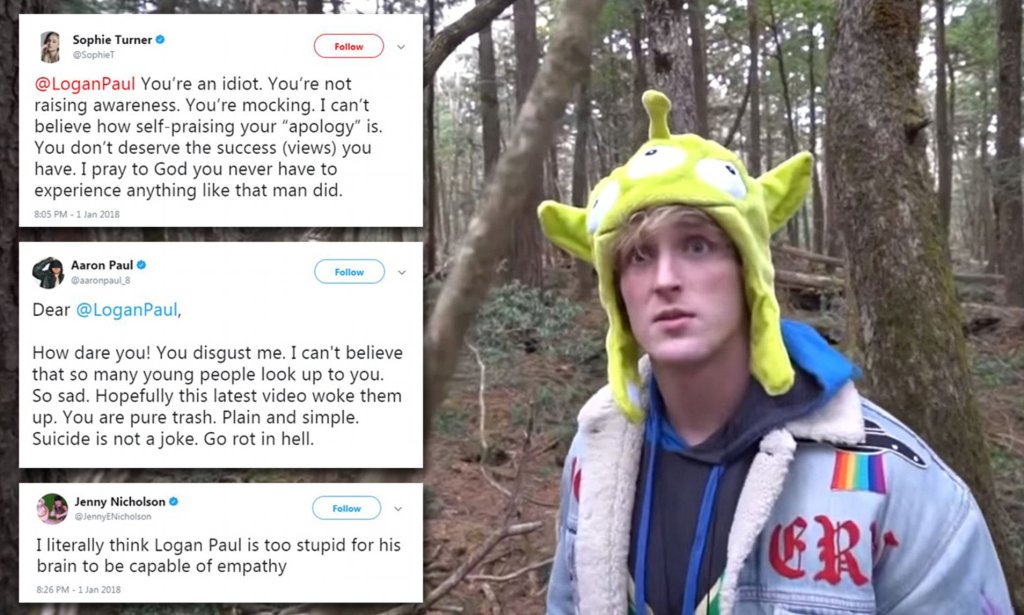
Anything for fame. It’s no shock that the stunts constantly pulled by Logan Paul are nothing more than cheap in an attempt to further his fame.
The only thing most kids want nowadays is to be famous on the internet and with how easy the internet allows it to begin is something that makes me wonder if there can be any regulation on this. Obviously it would be impossible because then it gets complicated on how values are portrayed and what about them would need to be regulated. Perhaps the only way to regulate anything begins at home with parents reinforcing values and taking control of how much time a child spends on social media. Maybe, some form of regulation starts at home and the responsibility is shared with parents and the social media giants.
This article comes from Maggie Haberman and Annie Karni from The New York Times. They write about Trumps week where he has been finding himself in hot water. They mention that it’s really himself putting himself in this situations where its coming to light some of the things he has been saying about fallen American Soldiers as well as down playing Covid-19 to the American People.













 SOCIAL MEDIA & SOCIETY